

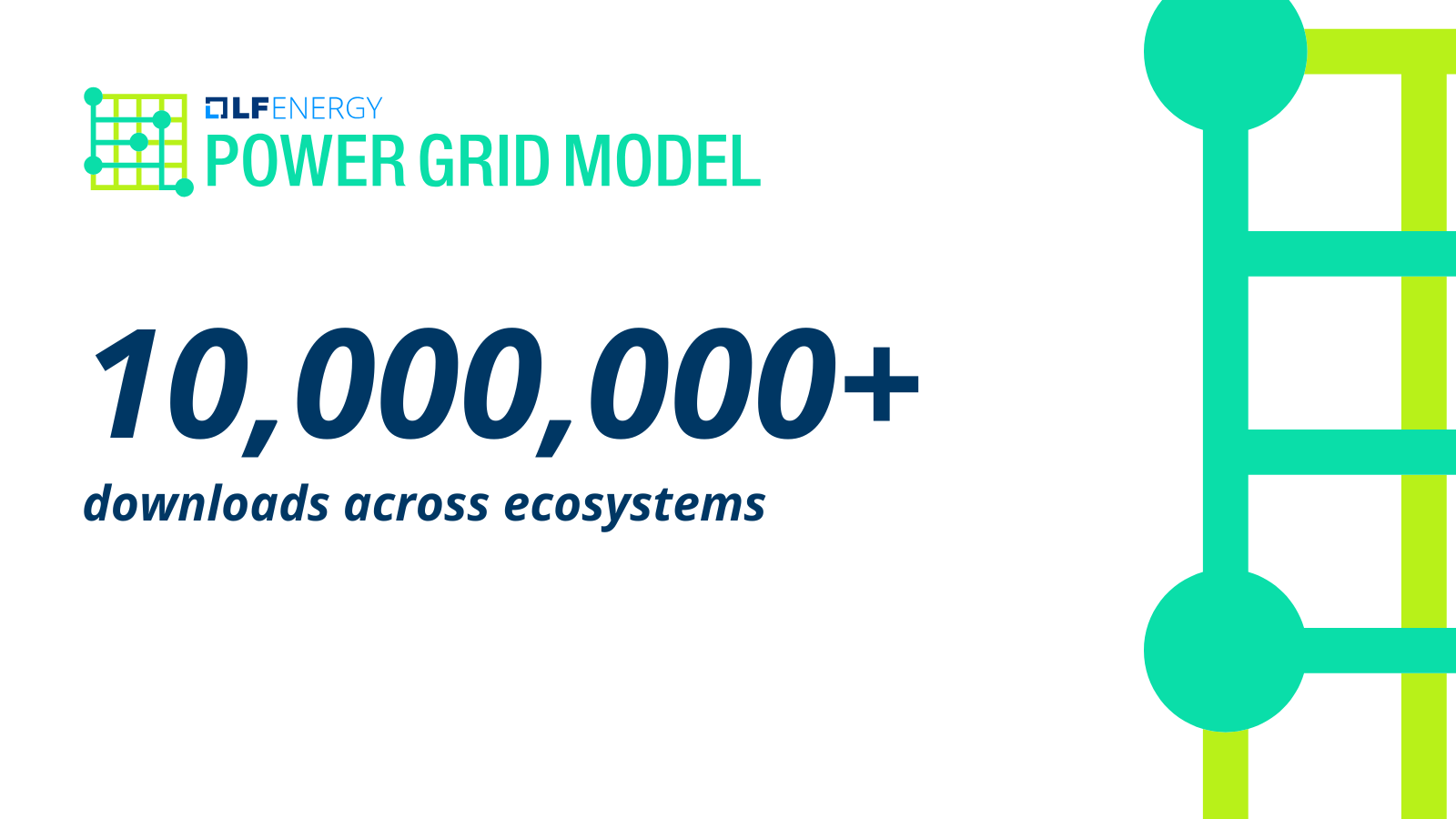
Global adoption of Power Grid Model surpasses 10 million downloads
The LF Energy Power Grid Model (PGM) project has reached a major milestone: over 10 million downloads worldwide.
What started as an internal grid calculation engine at Alliander has grown into a widely used open source solution, supporting organizations, researchers, and developers across the global energy sector. Today, Power Grid Model has reached an important milestone: over 10 million downloads worldwide. A milestone we are proud of!
10 million downloads across ecosystems
The global adoption of Power Grid Model is reflected in its download numbers across Python ecosystems:
- Over 5 million downloads via PyPI
- Nearly 5 million downloads via conda-forge
From internal need to global collaboration
Power Grid Model originated from a practical need: enabling faster, more efficient, and scalable grid calculations for analysis and simulation.
While initially developed within Alliander, it quickly became clear that this challenge was shared across the energy sector. Grid operators, solution providers, and academic institutions all face similar demands when it comes to planning and operating increasingly complex electricity networks.
By releasing the model as open source, the project opened the door to broader collaboration. Since then, the community has steadily grown, with contributions and adoption from organizations such as Enexis, Stedin, RSE, TU Eindhoven, and SOPTIM. The project’s inclusion in LF Energy significantly increased its international visibility and accessibility.
In 2026 alone:
- 333 contributions were merged
- 35 contributors actively contributed to the project
Alongside this active contributor base, there is a large and growing group of users applying the model in their own environments. Many of them contribute back by reporting issues, suggesting improvements, or submitting code changes.
This continuous feedback loop has led to a more robust, efficient, and versatile model, supporting a growing range of use cases in grid analysis, planning, and simulation. Today, Power Grid Model is recognized among the leading open source tools for power system analysis (source: https://github.com/ps-wiki/best-of-ps?tab=readme-ov-file)
A strong core team, powered by a global community
At the core of the project is a focused team of six specialists: a Product Owner, four scientific software engineers, and a power system consultant. Together, they ensure the ongoing development, maintenance, and quality of the model.
At the same time, the project thrives because of its open nature. Contributions from across the ecosystem bring clear benefits:
- Continuous feedback and new perspectives from real-world users
- Faster innovation through shared development efforts
- Improved quality and reliability via broader validation
- Stronger collaboration across organizations working on energy system digitalization
This combination of dedicated core team plus active community allows the project to evolve rapidly while maintaining high standards for performance and reliability.
Supporting the energy transition
As electricity grids become more complex due to decentralization, electrification, and renewable integration, the need for scalable and high-performance simulation tools continues to grow.
Power Grid Model supports this transition by enabling:
- Fast and accurate power flow calculations
- Scenario analysis for grid planning
- Simulation of network behavior under different conditions
By making these capabilities openly available, the project contributes to a more transparent, collaborative, and innovative energy sector.
Celebrating the milestone with the community
The milestone of 10 million downloads was recently celebrated during the annual Power Grid Model meet-up. Developers, users, and contributors came together to exchange insights, share experiences, and explore future developments.
Moments like this highlight what makes open source powerful: collaboration, shared ownership, and continuous learning.
About Power Grid Model
Power Grid Model is an open source grid calculation engine designed for high-performance analysis, simulation, and optimization of electrical networks. It enables fast and reliable calculation of power flows and voltages, supporting both operational and planning use cases.

