


An open source Python framework for modeling, simulating, and optimizing time-dependent systems in water, energy, and environmental domains.
About RTC-Tools
RTC-Tools is an extensible open source framework designed for the modeling, simulation, and optimization of complex, time-dependent systems with interconnected components. Supporting advanced decision-making approaches such as model-predictive control, RTC-Tools enables users across water and energy sectors to optimize real-world operations – from reservoirs and canal networks to hydropower facilities, pumped-storage systems, and battery energy storage systems (BESS).
Originally developed in 2015 by Deltares, a leading Dutch research institute for water and subsurface environments, RTC-Tools has since been deployed globally. Engineers, researchers, and operators use RTC-Tools to improve reliability, efficiency, and sustainability in water management and energy system operations. Its modular architecture, Python-based extensibility, and solver-agnostic design make RTC-Tools suitable for a wide range of applications, from operational control to long-term scenario planning.

Key Features
Flexible Modeling & Computational Framework
RTC-Tools supports the specification of complex dynamical systems and the solution of linear, nonlinear, continuous, and discrete optimization problems. Users can build models using Python or Modelica, an open standard for modeling physical systems.
Multi-Objective Optimization
Operational goals, such as maximizing energy production, minimizing spill, maintaining water levels, or reducing costs, are implemented as Python classes. RTC-Tools handles prioritization through weighting factors or lexicographic goal programming, enabling realistic tradeoffs that reflect operational priorities.
Uncertainty Handling
Real-world operations often involve uncertainty: hydrological forecasts, market signals, reservoir states, or battery state-of-charge. RTC-Tools supports ensemble forecasts to represent predictive uncertainty and automatically generates multi-stage control trees. Its optimization-under-uncertainty framework naturally integrates risk constraints using value-at-risk and conditional value-at-risk formulations.
Solver-Agnostic Integration
RTC-Tools abstracts solver details for the user while supporting a wide ecosystem of optimization solvers, including:
-
Open source: CBC, HiGHS, Ipopt
-
Commercial: Gurobi, CPLEX, Knitro
This flexibility allows users to tailor performance, licensing, and computational requirements to their environment.
Ecosystem and Extensions
RTC-Tools is part of a broader ecosystem of open source tools supporting environmental, water, and energy modeling. Several complementary libraries extend RTC-Tools for specialized applications:
-
RTC-Tools Channel Flow
https://github.com/Deltares/rtc-tools-channel-flow
Tools for modeling and optimizing open-channel hydraulic systems. -
RTC-Tools Hydraulic Structures
https://rtc-tools-hydraulic-structures.readthedocs.io/en/latest/
Components for simulating and optimizing hydraulic infrastructure. -
RTC-Tools Simulation
https://rtc-tools-simulation.readthedocs.io/en/latest/
Simulation framework for reservoirs and nonlinear system behavior. -
Mesido – Multi-Energy Systems Optimization
https://github.com/Multi-Energy-Systems-Optimization/mesido/
A design and planning tool for thermal and multi-energy networks. -
Battery Energy Storage Systems (BESS)Examples of energy strading and storage.
This ecosystem enables RTC-Tools to serve as a foundation for diverse applications spanning hydrology, power systems, environmental management, and multi-energy system design.
RTC-Tools was contributed to LF Energy in 2025 by Deltares.
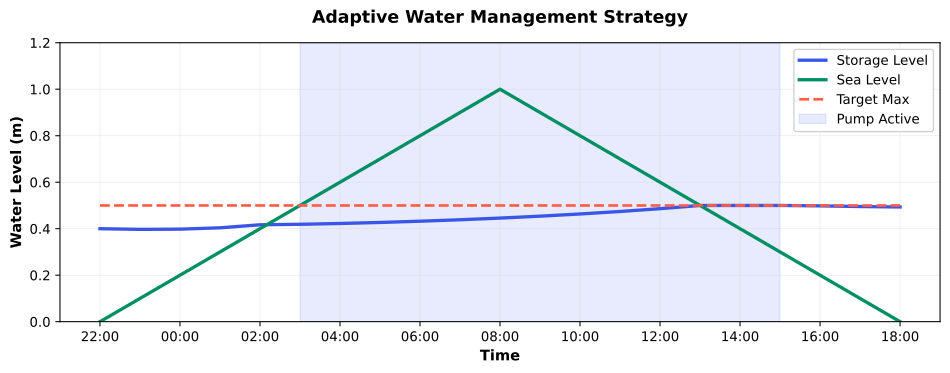
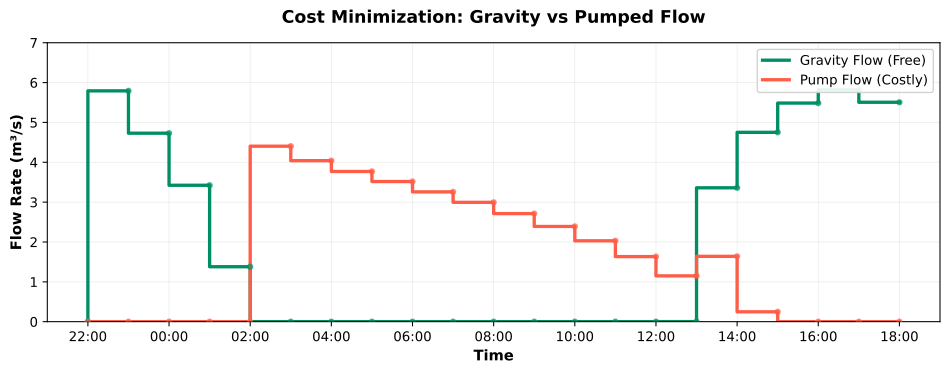
This example demonstrates RTC-Tools’ mixed-integer optimization for lowland water systems. The optimizer minimizes energy costs by intelligently switching between free gravity flow and pumping, while maintaining water levels within safe operational targets. See the full example.
RTC-Tools Videos
RTC-Tools Integration & Energy Trading Use Cases: Overview - Jorn Baayen, PortfolioEnergy
Upcoming Meetings
View the calendar of all LF Energy events
Project Special Interest Group: Grid Simulation and Modeling
Project Lifecycle Stage: Sandbox
