

Summary Signal: TenneT TSO B.V. achieved a 10× performance improvement in grid security analysis by building ReFlow, an orchestration platform powered by the LF Energy open source project PowSyBl. The solution reduced grid calculation times from minutes to seconds, deployed in five months, with no proprietary licensing required.
The challenge
At System Operations at TenneT Netherlands, grid security is a 24/7 responsibility. The team runs a continuous stream of analyses, N-1 security studies, congestion management and capacity calculations, that underpin safe operation of the high-voltage grid across the Netherlands.
Over recent years, that workload has grown significantly faster than traditional tooling could handle. Larger datasets, higher time resolutions and increasing regulatory requirements were all pushing against the limits of the existing solution. Calculation time for the European intraday coordinated security analysis process took longer than the required time resolution. For operators making real-time decisions, that’s not a minor inconvenience, it’s a constraint on what’s operationally possible.
Congestion has become an equally critical challenge. In the Netherlands, congestion represents a major direct and opportunity cost to society. TenneT addresses this on multiple fronts: through new congestion management products and market design, by expanding physical capacity, and by making better use of the assets already in place. That includes weather-based dynamic line rating, ML-driven topology optimisation, and other advanced operational measures.
Each of these initiatives delivers value on its own, but the real impact emerges when they are fully integrated into the security assessment process. A countermeasure that resolves an oscillation, for example, may unintentionally introduce congestion elsewhere. When all analyses feed back into a single, coherent assessment framework, alternative less- or even non-costly solutions can more easily be identified.
A further potential benefit lies in outage planning. Today, TenneT primarily assesses whether a planned outage can be executed safely within the prevailing system conditions. With more advanced, integrated security assessments, this perspective can be reversed: instead of validating planned outages, it should become possible to proactively identify future time windows in which outages can be planned. This shifts outage planning from a constraint-driven process to an opportunity-driven one, improving both operational flexibility and asset utilisation.
The team needed technology to become an enabler, not a bottleneck.
The engine: PowSyBl
The foundation of TenneT’s new approach is PowSyBl (“Power System Blocks”), an open source framework for electrical grid modelling and simulation hosted by LF Energy. PowSyBl provides the core computational building blocks for transmission grid operations: load flow analysis, security analysis, sensitivity analysis, remedial action optimisation, and network visualisation. It reads and writes CIM-CGMES — the industry-standard grid data exchange format — natively, alongside a range of other formats, making it well-suited to the interoperability demands of European grid coordination.
PowSyBl is already in production at some of Europe’s most operationally significant organisations. RTE, the French TSO, maintains the project and uses it across its grid operations. BalticRCC and Coreso, two of Europe’s Regional Coordination Centers, rely on it for the European Merging Function, coordinated security analysis, and capacity calculation. TenneT joins this group as the latest production adopter, bringing PowSyBl into a new operational context: high-throughput, automated grid security analysis at national TSO scale.
“We consider PowSyBl the most advanced open source power-system analysis engine available,” says Hugo Pfister, Manager Grid Security Applications at TenneT Netherlands. “We benefit directly from years of investment by RTE and the broader LF Energy community.”
The solution: ReFlow
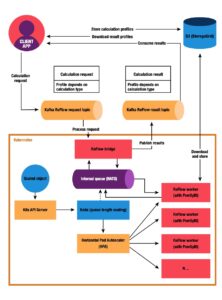
To deploy PowSyBl at the scale and automation level TenneT requires, the team built ReFlow, an in-house orchestrator for PowSyBl’s analytical capabilities.
ReFlow consumes standardised CIM/CGMES 3.0 inputs — including domestic and foreign network models and operational forecasts — and automatically executes the required security analyses by running multiple PowSyBl calculations in parallel. It automatically deploys the necessary number of calculation pods, processes the results, and terminates them once the job is complete, ensuring efficient resource usage at every step.
The results are significant. Compared to the previous solution, TenneT has observed at least tenfold performance improvements across standard grid security processes.
“By embedding PowSyBl within ReFlow, we can use it in a highly automated, mission-critical context,” Pfister explains. “ReFlow is built on a ‘single deployment, multi-customer’ principle. We build once, deploy once, and scale on demand.”
A key architectural principle throughout is modularity. ReFlow is designed for flexibility and to avoid vendor lock-in by allowing the best calculation engine to be selected for each analysis type. While PowSyBl is the primary engine for static security assessment, the architecture makes it straightforward to integrate new engines as grid operations evolve to include dynamic security assessment, short circuits, and more. These could be proprietary or other open source engines, such as TenneT’s own Odina, an in-house modular network analysis toolbox under consideration for open source publication with LF Energy, developed for faster, more scalable grid calculations.
How it was built
ReFlow went from project start to first production release in five months, October 2025 to March 2026.
Two factors drove that pace. First, TenneT had access to a modern on-premises PaaS environment (Kubernetes, Kafka, S3-compatible storage) that allowed cloud-native design principles from day one. Second, and arguably more importantly, the development team consisted of software engineers embedded directly within the business, with deep firsthand knowledge of operational grid security processes. That eliminated the knowledge-transfer overhead that typically slows development when IT and operations are organisationally separate. It also proved essential for correctly interpreting PowSyBl’s outputs and rapidly incorporating the required logic adjustments into ReFlow’s orchestration layer.
The main challenge was aligning all data producers and consumers on common integration patterns and standardised data products across domains, a coordination effort that required time but ultimately strengthened the foundation for future scalability.
Why open source made the difference
For TenneT, the open source model wasn’t incidental to the project, it was structurally enabling.
“The open source model allowed us to adopt a state-of-the-art solution without a lengthy procurement process,” Pfister explains, “and it gives us the flexibility to adapt and extend the tooling to our specific needs. More importantly, open source promotes knowledge sharing within the industry and makes high-quality software accessible to smaller TSOs, which strengthens the collective digital capabilities needed for the energy transition.”
“Beyond its technical benefits, the open source model acts as a catalyst, enabling engineers and specialists to move beyond technology constraints and think in terms of process opportunities.”
That philosophy extends to what comes next. If ReFlow’s core components are found to be sufficiently general — not TenneT-specific — the team is considering open sourcing the platform itself. At minimum, this case study is intended as concrete reference architecture: a clear approach for how any TSO facing similar scaling pressures can design and implement a comparable solution.
ReFlow and PowSyBl operate behind the scenes. The team is now developing a new operator-facing interface called Nexus. Nexus seamlessly integrates these advanced analytical capabilities into the daily operational workflow, providing operators with a single, coherent view of grid security and congestion-related insights. This tight coupling between advanced computation and operator decision-making will be the subject of a future case study.
Key outcomes
- 10× performance improvement across standard grid security processes
- Algorithm-driven scenario calculation now possible at scale
- Higher time resolutions supported for European processes
- Vendor lock-in eliminated through modular, standards-based architecture
- Production deployment achieved in five months from project start
- From constraints-thinking to possibility-thinking
About TenneT TSO B.V.
TenneT TSO B.V. operates the high-voltage electricity transmission network in the Netherlands and a large part of Germany. Hugo Pfister leads the Grid Security Applications team at TenneT Netherlands, where he has worked for over nine years. Learn more at tennet.eu.
About PowSyBl
PowSyBl (Power Systems Blocks) is an open source framework written in Java for modelling power systems, performing power flow calculations, running contingency analyses, and supporting capacity calculation. Originally developed by RTE, the French transmission system operator, PowSyBl is hosted at LF Energy under neutral open governance. It is used in production by multiple European TSOs and regional coordination centres. Learn more at powsybl.org.
About LF Energy
LF Energy is an open source foundation focused on the power systems sector. As a part of the Linux Foundation, LF Energy provides a neutral, collaborative community to build the shared digital infrastructure that will modernise the grid and accelerate the energy transition. Its projects address the needs of utilities, grid operators, and technology vendors to create production-grade open source software for a decarbonised energy future. For more information, please visit lfenergy.org.