

Summary: Every SEAPATH release ships with machine-readable SBOMs and continuously tracked vulnerability status, giving the manufacturers and grid operators who build on it ready-made evidence for their Cyber Resilience Act (CRA) and NIS2 obligations. These are the six practices behind that work, and how other open source projects can apply them.
Why upstream projects should care
RTE runs SEAPATH, LF Energy’s open source real-time virtualization software for digital substations, in production across six substations through its R#SPACE program, with four more planned by year end. The stakes for grid infrastructure are high, as Spain’s 2025 blackout showed, and software running substations sits squarely inside two EU regulations.
As a non-commercial open source project, SEAPATH itself carries limited direct obligations under the CRA. The organizations that build on it carry far more. Equipment manufacturers that ship SEAPATH in a product face full CRA product obligations, often in the important or critical product classes. Grid operators are essential entities under NIS2, with supply chain security requirements.
Those obligations are already live. Meeting the 24-hour reporting requirements of vulnerabilities under the CRA only works if a manufacturer already knows what is inside its product and which vulnerabilities touch it. Much of that knowledge starts upstream. SEAPATH’s answer is to produce it once, in the open, for everyone.
“We refuse to shift the cybersecurity burden to downstream adopters.” The SEAPATH commitment, as presented by Mathieu Dupré, SEAPATH maintainer, Savoir-faire Linux.
Practice 1: Generate an SBOM in CI for every release
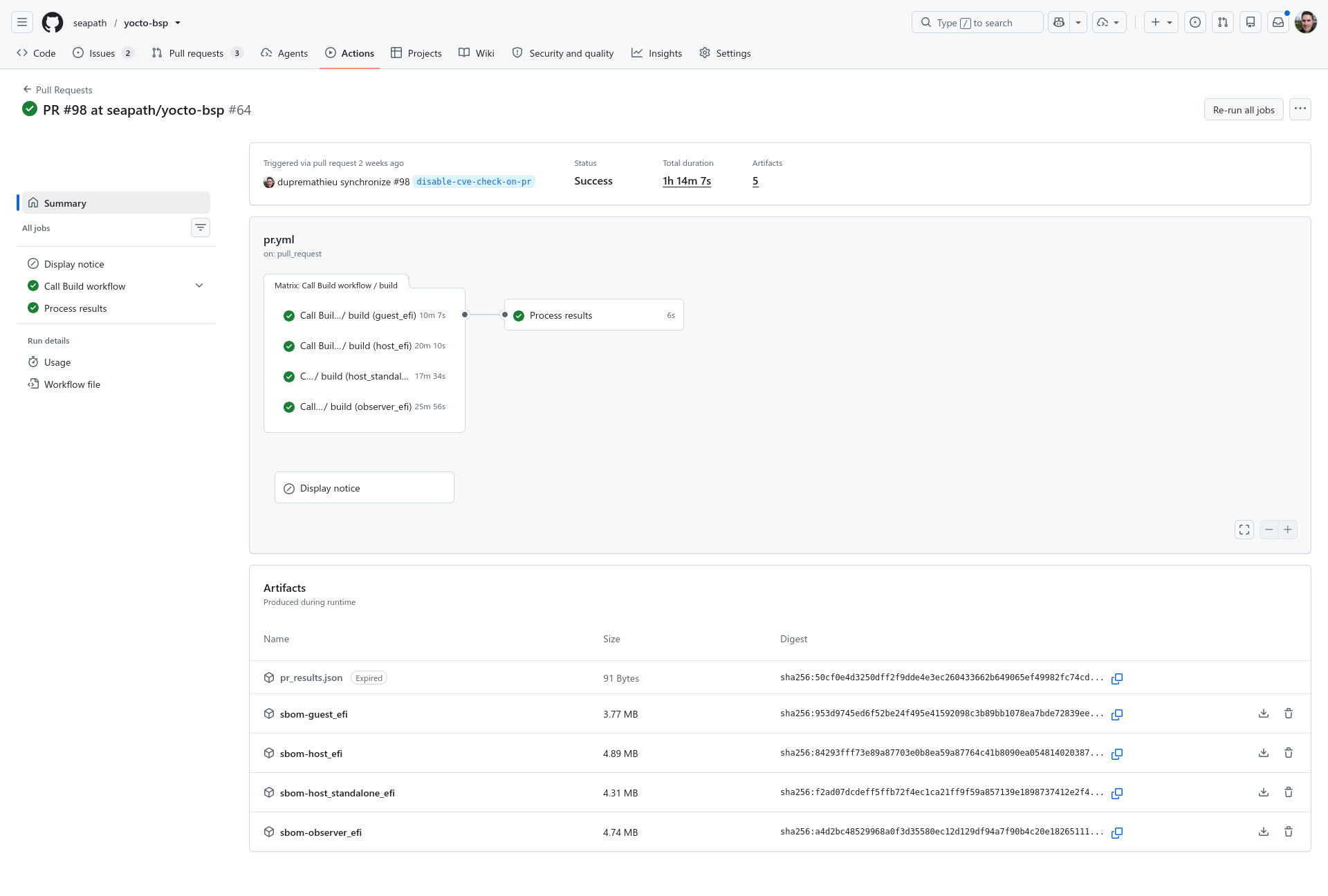
A software bill of materials (SBOM) is a machine-readable inventory of every component in a build. SEAPATH combines the Linux kernel, KVM, QEMU, Ceph, Open vSwitch, and Pacemaker across Debian, Yocto, and SLES flavors, so its inventory can’t be maintained by hand. SEAPATH generates SBOMs automatically at build time in GitHub Actions, for every flavor, in SPDX 2.x and 3.x, the open SBOM standard hosted by the Linux Foundation. Because SPDX is a standard, mainstream vulnerability scanners can read the output. The SBOMs are published alongside the release images at releases.seapath.org.
Takeaway: Choose an open SBOM format, generate it in the same pipeline that builds the release, and publish it next to the artifacts.
Practice 2: Keep scanning after release, and alert on new vulnerabilities
A release that was clean on the day it shipped won’t stay clean, because new CVEs are disclosed every day against components it already contains. So SEAPATH doesn’t scan once at build time. VulnScout, an open source vulnerability analysis tool developed by Savoir-faire Linux, reruns on a schedule in a GitHub workflow against the SBOMs of SEAPATH’s published releases. It correlates each SBOM with the Yocto build system’s own CVE status file, the Debian security tracker, public vulnerability databases, and the project’s previous analyses, then produces an updated SBOM and a report. Each vulnerability is tracked as patched, unpatched, or not applicable. When a newly disclosed vulnerability affects a release, the scheduled job fails, which is the alert: maintainers see the affected component and its status directly in the workflow results.
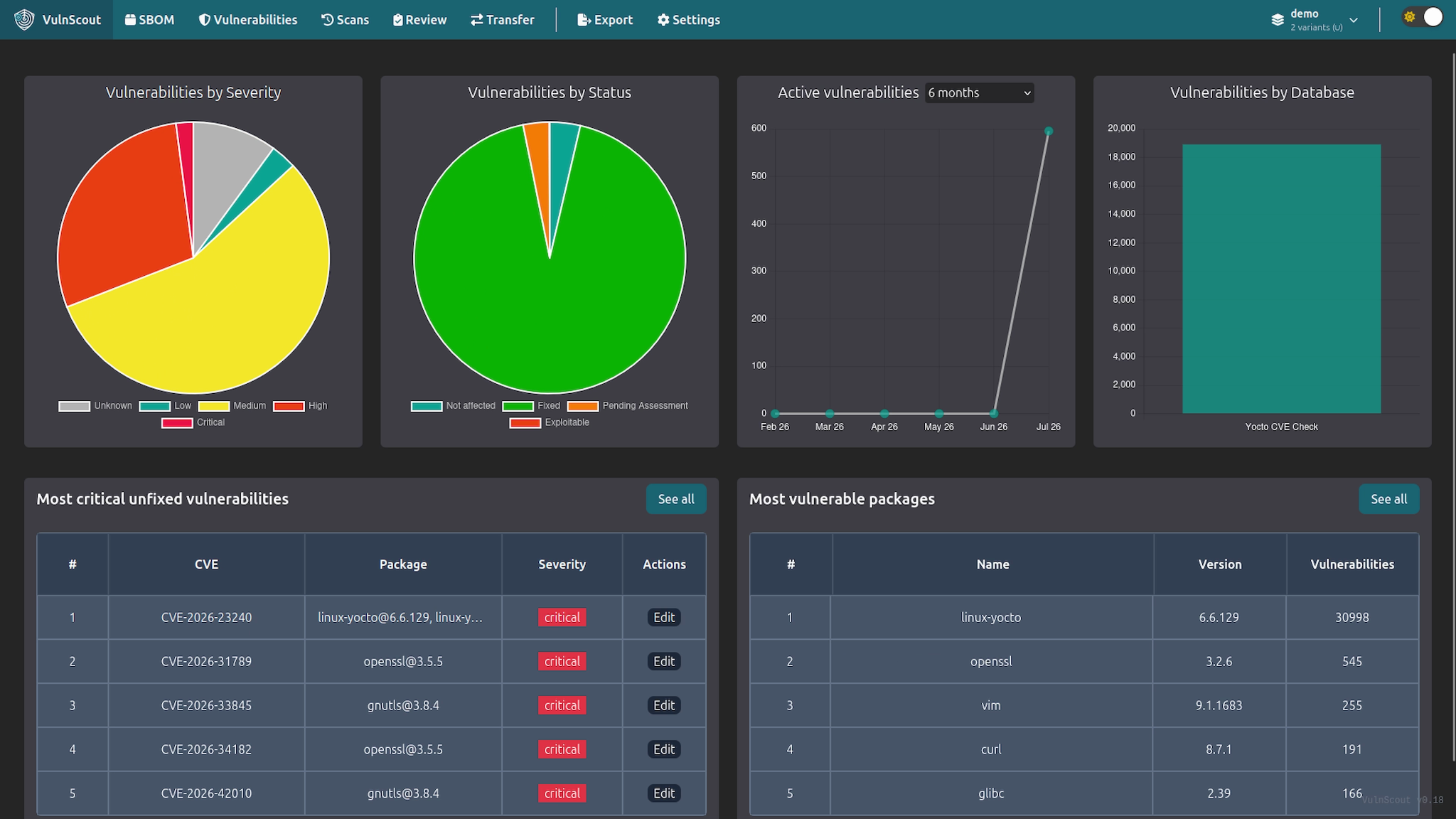
The team chose VulnScout over GitHub’s Dependabot because VulnScout aggregates several sources, including Yocto’s vulnerability status, which Dependabot does not cover.
Takeaway: Scanning at build time tells you a release was clean when it shipped. Scheduled scanning tells you whether it still is. Pick a scanner that understands your build system, not only your package manifest.
Practice 3: Publish vulnerability diffs between releases
Practice 2 watches each release over time. Practice 3 compares one release with the next. Using the tracked status for both versions, VulnScout shows which vulnerabilities a new SEAPATH version fixes, which remain open, and which are new. For a manufacturer deciding whether to move to the new version, that comparison is the evidence it needs for its own risk assessment and reporting.
Takeaway: Release notes should say what changed in your security posture, not only in your features.
Practice 4: Give reporters a private channel
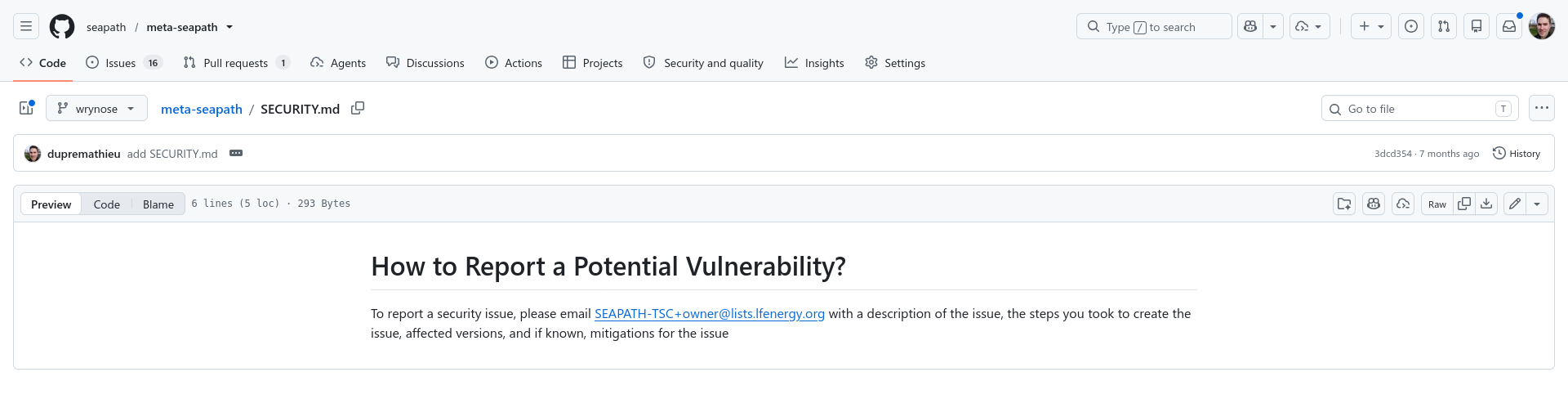
Every SEAPATH repository carries a SECURITY.md file that routes reports to a restricted SEAPATH Technical Steering Committee mailing address and asks for a description, reproduction steps, affected versions, and known mitigations. The project has identified an RFC 9116 security.txt file, a standardized machine-readable contact file on the project website, as a next step.
Takeaway: SECURITY.md in every repository is the baseline. security.txt makes the same contact discoverable by automated tools.
Practice 5: Write down where your responsibility ends
SEAPATH is explicit about what it supplies and what adopters own:
| SEAPATH supplies upstream | Equipment manufacturers own | Grid operators own |
|---|---|---|
| SBOMs with each release | Final product SBOM and risk assessment | Deployment risk, qualification, and patch decisions |
| Continuous CVE detection and triage status | Integration-specific security measures and support period | NIS2 risk management and incident response |
| Security policy and coordinated disclosure | Conformity assessment, EU declaration, and CE marking | |
| Hardened baseline and update evidence |
“SEAPATH supplies reusable evidence. Manufacturers and operators retain accountability.” From Mathieu Dupré’s LF Energy Summit Europe 2026 presentation.
The same boundary shapes how releases are handled. Security practice favors frequent patches and a short exposure window. Grid operations favor leaving a running substation node untouched, because requalification and on-site testing can take months to years. SEAPATH treats publication and deployment as separate decisions: the project minimizes the time needed to produce a trustworthy release package, and grid operators assess that package against their own qualified configuration and decide when to deploy. Fine-grained CVE status is what makes that assessment possible.
Takeaway: A short, written compliance boundary saves every adopter from inferring one, and keeps the project from implying obligations it can’t meet.
Practice 6: Scale triage with configuration-aware filtering
Since the Linux kernel became its own CVE Numbering Authority in 2024, it has assigned nearly 2,000 CVEs in six months, and other widely used projects show a similar, smaller trend. Most kernel CVEs don’t affect SEAPATH because they involve drivers or features its configuration doesn’t enable, but each still needs a status, and a small maintainer team can’t review them all by hand.
SEAPATH’s approach is to pre-triage kernel CVEs using analysis from the Civil Infrastructure Platform (CIP), the Linux Foundation project that maintains super long-term support kernels for industrial systems, filtered against SEAPATH’s actual kernel configuration. Dupré noted this can set aside around 75% of kernel vulnerabilities, and more for a leaner kernel. The team is also exploring AI-assisted filtering through VulnScout’s API and Model Context Protocol (MCP) interface, an open standard that lets AI agents call external tools, to check whether SEAPATH’s code is actually affected.
Takeaway: Filter by what you actually build. A minimal configuration is a security practice as well as a performance one.
Why this works in the open
Every piece of this pipeline is open and reusable: SPDX for SBOMs, VulnScout for analysis, GitHub Actions workflows in SEAPATH’s public repositories, and CIP for kernel triage. Because the evidence is generated in public CI, adopters can verify how it was produced rather than taking it on trust. And because the work happens once, upstream, every manufacturer and operator building on SEAPATH starts from the same baseline instead of each rebuilding the same compliance layer.