Why OpenADR?
OpenADR is a widely adopted protocol for automated, standards-based demand response. It enables grid operators and utilities to communicate signals such as pricing, events, and capacity limits to energy-consuming devices and systems in real-time.
OpenADR is used globally to:
- Reduce grid strain and balance load
- Enable customer participation in energy markets
- Integrate flexible, distributed energy resources
- Support regulatory compliance for demand response programs
What’s New in OpenADR 3.1?
OpenADR 3.1 modernizes the protocol with significant improvements in usability, flexibility, and developer-friendliness:
- RESTful architecture and JSON messaging make it simpler to implement and integrate
- Maintains core OpenADR concepts (events, reports, etc.) while streamlining complexity
- Easier adoption for VENs (Virtual End Nodes) with modular implementation options
- Greater alignment with Common Information Model (CIM), facilitating broader interoperability
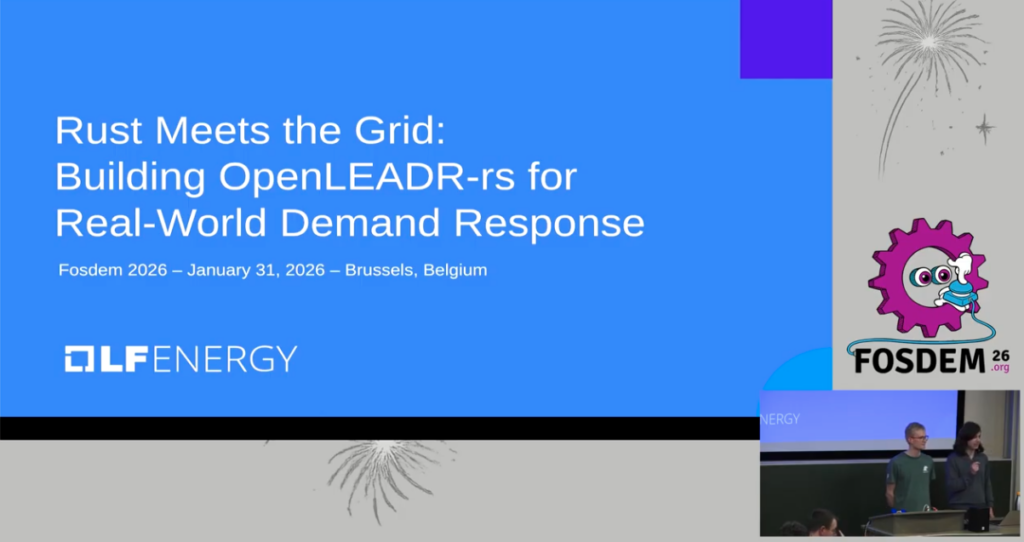
OpenLEADR 3.1, developed in Rust, provides a highly reliable, memory-safe platform for critical infrastructure.
Why Rust?
OpenLEADR 3.1 is built in Rust, a modern language known for safety, performance, and reliability – making it ideal for the high-assurance needs of grid infrastructure.
Benefits include:
- Memory safety and secure execution
- Easy deployment as portable, standalone binaries
- Growing adoption across infrastructure and embedded systems communities
What’s Included in OpenLEADR 3.1?
OpenLEADR 3.1 provides:
- A robust VTN (Virtual Top Node) and VEN (Virtual End Node) implementation
- Support for CRUD operations on programs, events, reports, VENs, and resources
- Authentication and authorization mechanisms
- High test coverage (166 of 168 tests from the OpenADR Alliance suite pass)
- Currently excludes support for the webhook mechanism (pending spec update)
- VTN support for signalling via MQTT and WebSockets
- VTN support for resource groups (to be standardized in OpenADR 3.2)
Use Cases
OpenADR 3.1, as implemented by OpenLEADR, enables diverse energy flexibility use cases:
- Grid-Aware EV Charging: Dutch Distribution System Operators (DSOs) will use OpenADR 3.1 to send static and dynamic grid capacity profiles to Charge Point Operators (CPOs)
- Dynamic Price Signals: Communicate time-sensitive pricing to end-user devices or systems
- Load Management & DER Integration: Enable smarter orchestration of distributed assets in real time
Governance & Community
OpenLEADR is governed by the LF Energy community under the guidance of its Technical Steering Committee (TSC), with contributors from:
Contributions, discussions, and collaboration take place on Slack, GitHub, and through public TSC meetings.